Ten comedians from around the world reflect on the challenges of translating their act to English.
Save this article to read it later.
Find this story in your accountsSaved for Latersection.

Now imagine partaking in that self-inflicted humiliation in a foreign country speaking a language youre still learning.
For many comics, its the natural progression from the corner theyve carved out in their native homeland.
Either way, its a considerable challenge that starts with taking on a working understanding of a foreign language.

But the journey to Americas ruthless stand-up clubs doesnt end there.
Some grew up functionally bilingual, while others had to learn English from scratch.
And every time I gave him ten pages, he would give me back seven pages.
I was like, There is some material missing, no?
Then I discovered the English language is so quick, efficient, and short.
You dont have to use that many words.

But an interesting fact is there are more words in the English language than in French.
Also, words in English mean what you hear.
They dont mean something else.

In Arabic its very complicated, in French its complicated, in Hebrew too.
Also, some expressions make my life much easier.
The day I discovered Got it, I was so happy.

In French, it takes so many words to say you understood what the people are telling you.
It means comedy is in the culture.
More than the French, they agree to be self-deprecating.

Now that I speak English, its not enough.
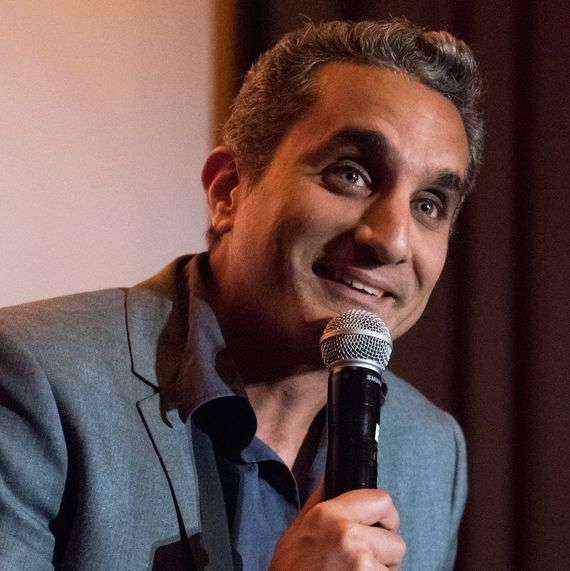
Bassem Youssef
Native Tongue: Arabic
[Comedy] is a third language.
I knew that my jokes were funny, but I didnt know why people didnt laugh.

I listened to myself and I wassayingthe jokes, nottellingthe jokes.
I think this was more a personal journey, much deeper than being funny or not.
Dealing with your insecurities.
The funny thing is that I cannot do stand-up in Arabic.
Its crazy now that Im thinking in English.
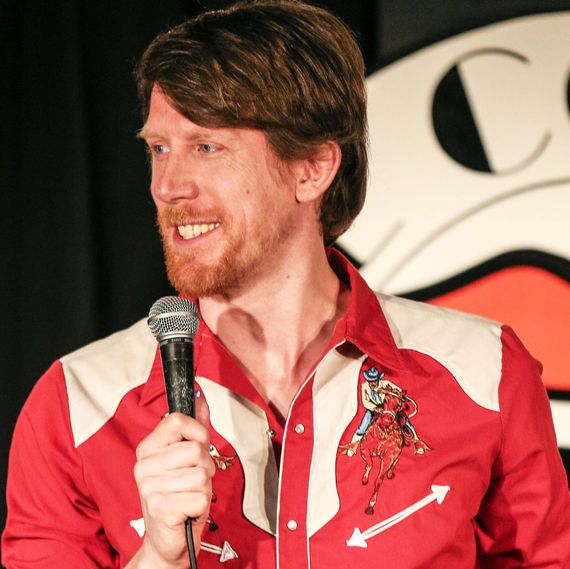
Flula Borg
Native Tongue: German
In Germany, I am not considered funny.

Im just considered very German.
Just another one of those guys waiting in line at the supermarket purchasing fresh blueberries.
That was always what it was like in Germany.

German, I think, has some very interesting words.
For example, we have something calledtreppenwitz.
It means staircase joke.
Im in the staircase.
This is what is wonderful about German.
I would say German has some more interesting words, but English has the most dope slang.
I did not understand how people know that she poops at parties.
This should not be something people would know.
Our word structure is very different.
In German, often the verb is at the very end.
What will happen in the end?
In English, it is not like this.
So this can make a structure of storytelling or a weird joke feel very different.
I feel like you have to do stand-up in the language that you think.
And for me, that is English.
It would be derivative.
I think Hindi is just a more direct language than English in those terms.
There are more direct ways to convey any emotions or what you want to convey in Hindi.
Different areas of the world throw different things at you.
Then you try and write more jokes like that.
Language is a bubble at the end of the day.
Whether I speak Hindi or not, I have an Indian face to my English.
Even my English is different from your English, and thats very visible onstage.
Thats an entity that I own.
Because its very tiring going to a different country and writing a whole new set for them.
You always want to end on the funny word.
In English that is very easy to do.
So German humor ends up being pretty different from English humor.
In English, you do have to get to the punch line faster.
I dont know if its different in any other language.
Theyre willing to let you go on a little bit longer.
So I dont think its a language thing, I think its a cultural thing.
[In English, if] you start any line with Bitch!
youre going to get a laugh.
which is like our cuss word for your mother.
Singaporeans talk really fast.
I have to remind myself to speak more slowly.
We speak quickly, so I have to slow down a little in America.
Especially having an accent, it just helps them understand more.
So I have to consciously slow down in America.
At least, I give a shot to.
English is a very short, right-to-the-point language, which is why stand-up works.
The more you talk, the more people are like,Hurry up, get to the point.
Everybody has their own way of talking, accents, and different words that they use.
For me its finding the word that everybody understands.
Spanish allows you to talk more, and the audience kind of respects that or is used to that.
In English, youve got to go fast.
If I speak too fast, some people might not understand what Im saying.
When I started doing stand-up, I would always remind myself,Go slow.
Because I speak fast already, so if you speak slow people will understand you.
Its not like youre speaking slow, youre speaking normal.
Everybody knows something about America, but nobody knows shit about Finland.
We have the saying in Finnish, but in Finnish everything is in passive form.
So in English its If Im completely honest and in Finnish its like If honesty is happening.
So things like that some parts of that bit can be translated, but some cant be translated.
Even if you find the exact translation of something, there might be hidden feelings.
Kind of like the tone, which can be completely different or wrong.
Its really hard to tell the tone in a second language.
Sometimes you just dont know the word and you just have to ask.
We say, Not even with an axe.
Like, I couldnt pass that car, not even with an axe.
Meaning I just couldnt do it.
How would an axe help unless it was with killing something?
We use that in everything.
Like you need an axe to do everything.
It could be, I couldnt find my keys, even with an axe.
There are way sillier ones.
The amount of words we have for a penis, for example.
There are so many and they are so funny.
Theres lots in English, too, but they are too weird.
Christian Schulte-Loh
In other European countries, people think Germans have just no sense of humor whatsoever.
I wasnt really aware that this was such a big thing, but apparently it was and still is.
They think Germans can be funny, but not intentionally.
I think I have two comedy brains.
If I do a one-hour show, maybe ten minutes of that would be the same in both languages.
The rest would be completely different.
You get away with more stuff in English.
People would even laugh.
If you literally said that in German, it would be too harsh.
[Its] the same with certain jokes.
In Britain, they drink more, so there is more energy in the room; its rougher.
In Germany, they watch it and sit through it.
I think in Britain there is more coding, sarcasm.
In Britain and America, if you say I love this guy, it doesnt mean youlovethe person.
You like the person.
In Britain, I think the entire society is being held together by sarcasm.
Its a very important tool to use.
When you talk about marriage and dating and Tinder, those subjects are international.
Talking about my kid and pregnancy we are the same in those areas.
Those jokes work on the same level.
There is a math behind the joke, and I respect the math when Im translating.
I can change the rhythm, I can make it quicker and make it slower.
I can play with the joke.
Its almost like reverse psychology.
What I think is amazing is there is a likability to a foreigner talking in English.
In my language I am considered an asshole.
In English, there is a likability behind the way I speak, and Im taking advantage of it.
Thats the craziest thing for me.
So thats what Im trying to run away from.
Because otherwise Im a category.
I dont want to be a category.
Yuriko Kotani
Native Tongue: Japanese
I dont think in Japan we even call it stand-up comedy.
Its more like two people talking, like a double act.
Right now my rhythm is an English rhythm.
In my case its about rhythm, so when Im writing or thinking material, its in English.
I must write it down in English.
One time a while ago, I MC-ed in Japan in Fukuoka.
So I translated my English set into Japanese.
Some stuff got laughs, but one bit I did the joke and the audience went Uuuhh.
They acknowledged the information.
Its live and learn.
As a Japanese thing this is not comedy, but its a general thing swear words were very interesting.
For example, in movies people say, Fuck you.
But this F-word can be used for everything.
Like, This fucking chair.
It becomes an adjective?
It becomes something like Get out or some similar meaning.
In Japan, we have swear words or something to say harshly or make others feel bad.
But the F-word can be used in many ways.
It is difficult, but it is awesome when you get a laugh.
It is just tremendous.
Anyone who wants to do it, Im telling you, kindly do it.
Sometimes you hear someone say its not good enough doing it in a second language.
Just go for it.
